Introduction
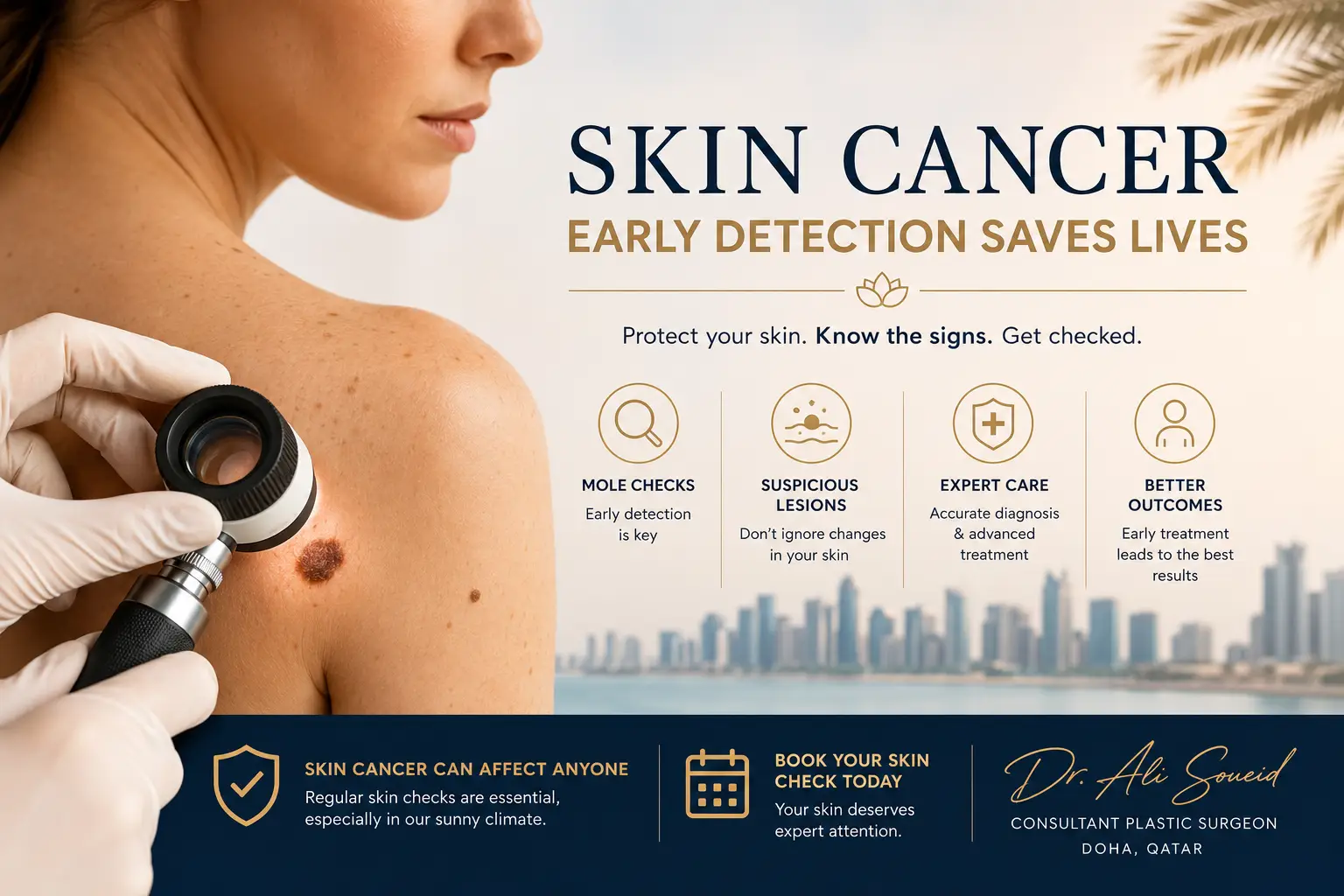
Skin cancer is one of the most common cancers worldwide, yet it is also one of the most treatable when detected early. Although many people associate skin cancer with fair-skinned populations, it can affect people of every skin colour and ethnicity, including those living in Qatar and the Middle East.
The strong year-round sunshine in Qatar means that ultraviolet (UV) exposure remains one of the most important preventable risk factors for skin cancer. Even individuals with naturally darker skin are not immune, particularly those with prolonged outdoor exposure, previous severe sunburns, or a family history of skin cancer.
Many patients delay seeking medical advice because they assume a mole is “probably nothing.” In reality, recognising suspicious lesions early can dramatically improve treatment outcomes and, in the case of melanoma, may save a person’s life.
This guide explains when a skin lesion should be assessed, how skin cancer is diagnosed, which lesions are most concerning, and why choosing an experienced plastic surgeon is important when biopsy or surgical removal is required.
Why Skin Cancer Matters in Qatar
Qatar enjoys sunshine throughout the year, with extremely high UV levels during much of the year.
Common risk factors include:
-
- Living in a sunny climate
-
- Outdoor occupations
-
- Recreational sun exposure
-
- Previous sunburns
-
- Fair skin
-
- Increasing age
-
- Family history of melanoma
-
- Previous skin cancer
-
- Multiple moles
-
- Immunosuppression
Many expatriates living in Qatar have accumulated sun damage from previous decades spent in Europe, Australia or North America before moving to the Gulf.
Skin cancer is therefore something every adult should understand—not fear, but recognise.
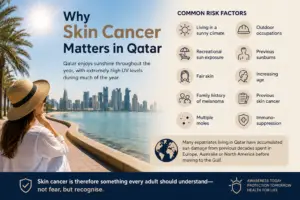
Living in Qatar’s high UV environment increases the importance of regular skin checks. Knowing the risk factors and recognising suspicious skin lesions early can lead to earlier diagnosis and more effective treatment.
Not Every Mole Is Skin Cancer
One of the biggest misconceptions is that every mole is dangerous.
The vast majority of moles are completely benign.
Other common skin lesions include:
-
- Epidermoid cysts
-
- Dermatofibromas
-
- Cherry angiomas
-
- Solar lentigines (“age spots”)
-
- Sebaceous hyperplasia
Many harmless lesions can closely resemble skin cancer.
Equally, some skin cancers appear surprisingly innocent.
This is why self-diagnosis is unreliable.
The Three Main Types of Skin Cancer
Basal Cell Carcinoma (BCC)
Basal cell carcinoma is the commonest skin cancer.
Fortunately, it rarely spreads elsewhere in the body.
However, untreated BCC can:
-
- Continue growing
-
- Destroy surrounding tissue
-
- Invade cartilage
-
- Invade bone
-
- Cause significant facial deformity
Typical appearance includes:
-
- Pearly bump
-
- Non-healing sore
-
- Recurrent bleeding
-
- Small visible blood vessels
-
- Persistent crusting
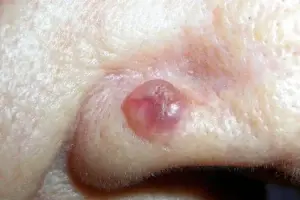
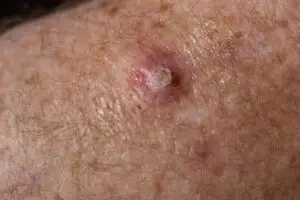
- Basal cell carcinoma (BCC) is the most common type of skin cancer. Although it rarely spreads to other parts of the body, early diagnosis and treatment are essential to prevent local tissue damage and achieve the best cosmetic outcome.
Squamous Cell Carcinoma (SCC)
Squamous cell carcinoma is more aggressive.
It often develops from chronically sun-damaged skin.
It may present as:
-
- Scaly plaque
-
- Thick crust
-
- Persistent ulcer
-
- Painful lesion
-
- Rapidly enlarging lump
Unlike BCC, SCC has the potential to spread to lymph nodes if left untreated.
Melanoma
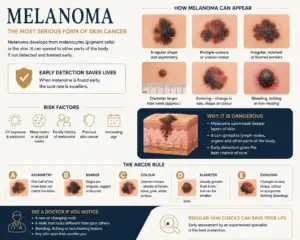
Melanoma is the most serious form of skin cancer.
Although less common than BCC or SCC, melanoma carries the greatest risk because it can spread throughout the body if diagnosis is delayed.
Fortunately, early melanoma has an excellent prognosis.
This makes prompt assessment essential.
The ABCDE Rule for Melanoma
Patients should remember the ABCDE rule.
| Feature | What to Look For |
|---|---|
| A | Asymmetry |
| B | Irregular Borders |
| C | Multiple or changing Colours |
| D | Diameter greater than approximately 6 mm (although melanomas can be smaller) |
| E | Evolution — any change in size, colour, shape, bleeding, itching or symptoms |
Evolution is often considered the single most important warning sign.
Other Warning Signs That Should Never Be Ignored
Arrange a medical assessment if a lesion:
-
- Changes rapidly
-
- Bleeds repeatedly
-
- Will not heal
-
- Forms a persistent scab
-
- Becomes painful
-
- Develops ulceration
-
- Starts itching persistently
-
- Changes colour
-
- Changes shape
-
- Appears different from your other moles (“Ugly Duckling Sign”)
Skin Cancer Is Not Always Dark
Many patients expect melanoma to be black.
In reality, skin cancers can be:
-
- Pink
-
- Red
-
- White
-
- Skin coloured
-
- Brown
-
- Blue
-
- Black
Some melanomas contain almost no pigment at all.
Should Every Mole Be Removed?
No.
Removing every mole is unnecessary.
Most lesions simply require:
-
- Examination
-
- Photography if appropriate
-
- Clinical monitoring
-
- Patient education
Only suspicious lesions usually require biopsy or removal.
How Is Skin Cancer Diagnosed?
Diagnosis begins with a thorough clinical examination.
This includes:
-
- Full history
-
- Assessment of risk factors
-
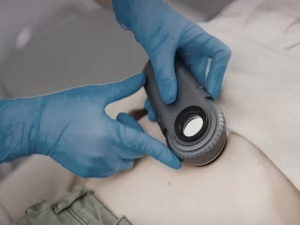
- Dermoscopic examination
-
- Clinical photography when appropriate
If a lesion appears suspicious, the gold standard is a biopsy, allowing microscopic examination by a specialist pathologist.
No AI app or photograph can replace histological diagnosis.
Why See a Plastic Surgeon?
Many patients are surprised that plastic surgeons play a central role in skin cancer management.
Plastic surgeons specialise in:
-
- Skin lesion diagnosis
-
- Skin biopsies
-
- Complete cancer excision
-
- Facial reconstruction
-
- Eyelid reconstruction
-
- Nasal reconstruction
-
- Ear reconstruction
-
- Lip reconstruction
-
- Scalp reconstruction
-
- Skin grafts
-
- Local flaps
The goal is not simply removing a lesion, but ensuring complete cancer clearance while achieving the best possible cosmetic and functional outcome—particularly for lesions on the face, eyelids, nose, lips, and ears.
Modern Surgical Treatment
Depending on the diagnosis, treatment may involve:
-
- Shave biopsy
-
- Punch biopsy
-
- Excisional biopsy
-
- Wide local excision
-
- Local flap reconstruction
-
- Full-thickness skin graft
-
- Sentinel lymph node biopsy (selected melanoma cases)
-
- Ongoing surveillance
Every treatment plan should be individualised.
Can Skin Cancer Be Prevented?
Although not all skin cancers are preventable, risk can be reduced by:
-
- Daily SPF 50+ sunscreen
-
- Wearing protective clothing
-
- Avoiding peak midday sun
-
- Wearing hats and sunglasses
-
- Avoiding tanning beds
-
- Monthly self-examination
-
- Annual skin checks for high-risk patients
Why Patients in Doha Choose Dr Ali Soueid
Dr Ali Soueid is a UK-trained Consultant Plastic Surgeon with over 25 years of experience in skin cancer surgery, reconstructive surgery, and facial reconstruction. He has treated thousands of skin lesions ranging from benign moles to complex skin cancers requiring advanced reconstruction.
At Cosmetic Aesthetic Plastic Surgery in Doha, patients benefit from:
-
- Comprehensive skin lesion assessment
-
- Dermoscopic evaluation
-
- Skin biopsies
-
- Mole removal
-
- Skin cancer surgery
-
- Facial reconstruction following skin cancer excision
-
- Careful scar placement and reconstruction to optimise both function and appearance
-
- Evidence-based follow-up and surveillance
Patients are assessed individually, with treatment recommendations based on clinical findings rather than unnecessary procedures.
Frequently Asked Questions
Should I have my moles checked every year?
If you have multiple moles, a previous skin cancer, a strong family history, or significant sun exposure, regular skin examinations are advisable. Your doctor can recommend the appropriate interval based on your individual risk.
Is mole removal painful?
Most skin lesions are removed under local anaesthesia. The procedure is generally well tolerated, and patients usually return home the same day.
Can a mole grow back after removal?
If a mole is only partially removed, some pigment may recur. Complete surgical excision is usually definitive for benign moles and is often recommended when a lesion is suspicious.
Will I always need stitches?
Not always. Small biopsies may heal without sutures, while larger excisions often require stitches and, in some cases, reconstructive techniques to achieve the best cosmetic result.
Final Thoughts
Most skin lesions are harmless, but distinguishing a benign mole from an early skin cancer requires experience, careful examination, and, when necessary, biopsy. Early diagnosis remains the most important factor in achieving successful treatment, particularly for melanoma.
If you notice a new, changing, bleeding, or non-healing skin lesion, arranging an assessment promptly is the safest course of action. For patients in Doha and across Qatar, seeking evaluation from a plastic surgeon experienced in skin cancer diagnosis and reconstruction ensures not only accurate treatment but also the best possible functional and cosmetic outcome.